

Students learning together
WealthWise Kids™ · Curriculum

Financial Foundations™ Curriculum

The research-backed K–12 financial curriculum — learned through story, play, and real-world experience, and one of the few that measures how students actually decide, with the FLIQ Score™.

Aligned to Jump$tart Standards + HQIM structure
Fully scripted — no finance background to teach
Measured by the FLIQ Score™ — real proof of growth
FERPA & COPPA compliant · Title IV-A eligible
★ Now piloting across Georgia, California & Illinois — expanding to D.C. and New Jersey · Built on decades of research into how children form money habits.
The curriculum at a glance
4
Grade-band curricula
21
Units
224
Lessons
8
Competency domains
One curriculum · every setting
Districts & SchoolsTeachersHomeschool FamiliesAfter-School & CommunityEarly Learning

Learn by doing

Kids don't memorize money — they make real decisions through stories, games, and simulations. That's what actually changes behavior.

Measured, not guessed

Every decision feeds the FLIQ Score — a real before-and-after you can show your board and your funders.

Habits that last

From a five-year-old's first coin to a senior's first paycheck, students build the instincts that shape a financial life.

A Look Inside

Get to know the curriculum.

The whole program at a glance — open whatever interests you. Each grade-band curriculum has its own details in the marketplace below.
Description

Financial Foundations™ is a complete K–12 financial curriculum built the way children actually learn — through characters, stories, and real decisions. Milo Peregrine™ guides every lesson while the WealthWise Kids crew brings each concept to life. Across four curricula and 224 lessons, students move from their first coin to their first paycheck — building not just knowledge, but the habits and confidence that shape a financial life. Every lesson is standards-aligned, fully scripted for educators, and measured through the FLIQ Score so growth is visible and reportable.

How it's taught

Financial Foundations teaches money through more than lessons. Younger students learn through stories and characters; every grade practices through interactive games and simulations; and older students apply it all in real-world capstones. Underneath, one thing never changes — students learn by making real decisions, and every decision is measured by the FLIQ Score. That blend of story, play, real-world experience, and behavioral measurement is what almost no other financial curriculum brings together — and it's why growth here is something you can actually prove.

The 8 competency domains
Earning
Spending
Saving
Giving
Borrowing
Investing
Protecting
Planning
Beyond the classroom

Financial Foundations reaches past the lesson plan. Each grade builds toward a capstone — a culminating project where students put it all together, from a middle-schooler’s financial blueprint to a senior’s full life plan. Older students can extend into real-world pathways: hands-on experiences that connect classroom decisions to real careers and community. And between sessions, interactive games and a student practice app keep the learning alive — every one of them quietly feeding the same FLIQ Score.

How we measure growth

Knowing about money doesn't reliably change what people do with it — so instead of a quiz, we measure the decisions students make during the lessons. A simple before-and-after gives educators, boards, and funders a real, reportable number showing behavior changed.

Saving+36 pts
Borrowing+33 pts
Planning+35 pts
Investing+38 pts

And it doesn’t live in a spreadsheet. Every score is tracked in the WealthWise Kids facilitator dashboard, where educators and administrators watch cohorts grow over time — and where signals from across the whole ecosystem (the classroom, the simulations, the practice app, and the games) roll into one longitudinal picture. When a board asks “where’s the proof, and how is it managed?” this is the answer: real tracking, retention, and visibility.

Illustrative sample of how FLIQ Score™ growth appears across the eight domains — a model, not published pilot results.
See how the FLIQ Score works →
The research behind it
27%
of U.S. adults pass a basic financial literacy test
FINRA, 2023
$1T+
in student loan debt held by borrowers under 35
Federal Reserve, 2024
56%
can't cover a $1,000 emergency
Bankrate, 2024
23¢
median Black household wealth per $1 white
Brookings, 2023
By age 7A child's money habits are largely formed by age seven — making K–2 the highest-leverage time to start. Whitebread & Bingham, Univ. of Cambridge (2013)
BehaviorKnowing about money doesn't reliably change what people do with it — practicing real decisions is what moves behavior. Consumer Financial Protection Bureau
StoriesCharacter- and story-based learning drives stronger recall and transfer than lecture alone. Learning-sciences research
CreditStudents in states that require personal finance graduate with measurably better credit and fewer delinquencies. Urban et al., Montana State / IZA (2022)
Read the full Research and Evidence Base →
What students gain
Learns money through stories, games, and real choices — not lectures
Builds confidence with money early, before habits harden
Sees themselves in the WealthWise Kids crew and in Milo, their guide
Practices real decisions in a safe place, so real-life ones feel familiar
Grows with the same framework from kindergarten through high school
What educators gain
Turnkey, fully-scripted lessons — no financial background required to teach
Aligned to the Jump$tart National Standards and the HQIM structure
FERPA and COPPA compliant — no personal financial data collected
Measurable growth to report to leadership and funders via the FLIQ Score
Flexible delivery — classroom, after-school, or community program
What families gain
Learning comes home — take-home prompts turn everyday moments into money conversations
Families can watch confidence grow through the FLIQ Score
Connects families to a supportive community of tips and encouragement
No cost or tech barrier at home — everything runs at school
Standards and compliance

Every lesson maps to the Jump$tart National Standards for Personal Financial Education. The program follows the HQIM structure districts use to evaluate curriculum, and is FERPA and COPPA compliant — the FLIQ Score is generated from anonymous decision patterns, never from personal or family financial data.

See It for Yourself

A real lesson, start to finish.

One of 224 — shown in full, nothing gated. This is exactly what a Financial Foundations lesson looks like.

Sample Lesson · Illustrative Preview · 1 of 224
Money Explorers™ · Sample LessonUnit 1.2 · Lesson 1 of 10 · K–2 · 45 min

Needs Come First

SpendingPlanning
Learning Target

“I can tell the difference between a need and a want, and explain why needs come first.”

Students can…
Name at least two things that are needs
Name at least two things that are wants
Explain why we pay for needs before wants
The Hook · Milo’s Backpack Problem

Milo is packing for a big trip — but his backpack only fits five things, and his list is much longer. The class helps him choose: which items does he truly need, and which are just wants that can stay home? One by one, students sort Milo’s list and discover that needs come first when space — and money — is limited.

Milo Peregrine — the WealthWise Kids guide
Milo Moment

“A need keeps you safe and healthy. When money is small, needs go in the backpack first.”

— Milo Peregrine
The idea keeps going — beyond the page
PlayLab™ · Interactive Game
Needs & Wants Sorter

Race the clock to pack Milo’s backpack — needs go in first.

WWK Adventures™ · Storybook
Two Dollars and a Horse

A story where a small spending choice turns into a very big deal.

One concept, taught three ways — lesson, game, and story — so it sticks. (Illustrative of how Financial Foundations connects across the WealthWise Kids ecosystem.)

FLIQ Score connection: this lesson builds the Spending Index — the foundational layer of financial judgment the FLIQ Score measures.
Request the full lesson →
The Curriculum Marketplace

Choose a curriculum.

Four complete grade-band curricula — license one, several, or the full K–12 set. Sample pricing shown for layout; final pricing is set with your team.

The Wyzmons™ — a learner for every stage, K–12
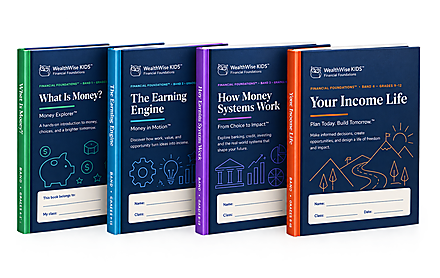
★ Best Value · Save 20%
K–12 Complete
All four curricula · 21 units · 224 lessons · every grade covered
$8,625$6,900 /site · year
You save $1,725 vs. buying all four
Annual site license · digital delivery · print kits ship separately
Money Explorers
Early Childhood Curriculum
Grades K–2 · Ages 5–8 · 4 units · 40 lessons
Description

For our youngest learners, money begins as a story. Children meet Milo and the crew and discover what money is, where it comes from, and the difference between what they need and what they simply want. Read-aloud stories, hands-on sorting, and playful interactive challenges turn each big idea into something a five-year-old can feel — building the first instincts of saving, sharing, and choosing on purpose. Every playful choice quietly feeds their FLIQ Score, so judgment can be seen forming from the very start.

Signature lesson by grade

A distinct, grade-specific flagship for every grade in this band — tailored to where students actually are.

KThe Needs & Wants Market
1Where Money Comes From
2Save · Spend · Share
FLIQ Score approach

At the Foundational level, the FLIQ Score watches for the first signs of financial judgment — can a child tell a need from a want, and choose to wait or save? It sets the baseline every later grade builds on.

Scope and sequence
1.1What Is Money?
1.2Needs and Wants
1.3Saving for Something
1.4Sharing and Giving
↓ Full scope and sequence (all grades)
Pricing · per school
4 units · 40 lessons Educator guide & support
Free Year-1 pilot · or request by invoice
Money Builders
Upper Elementary Curriculum
Grades 3–5 · Ages 8–11 · 5 units · 50 lessons
Description

Students step from stories into systems. Through interactive games, simulations, and real earning scenarios, they explore the many ways people make money, learn to spend with intention, and build their first real budgets and saving systems. Money becomes something they can plan with — and every decision they make inside a game or scenario sharpens the behavioral signal behind their FLIQ Score.

Signature lesson by grade

A distinct, grade-specific flagship for every grade in this band — tailored to where students actually are.

3The Earning Engine
4Build Your First Budget
5Smart Spender Showdown
FLIQ Score approach

At the Developing level, the FLIQ Score measures budgeting and planning behavior — whether a student can spread limited money across competing goals and stick to the plan.

Scope and sequence
2.1The Earning Engine
2.2Smart Spending
2.3The Saving System
2.4Budgeting Basics
2.5Money and Community
↓ Full scope and sequence (all grades)
Pricing · per school
5 units · 50 lessons Educator guide & support
Free Year-1 pilot · or request by invoice
Money Systems
Middle School Curriculum
Grades 6–8 · Ages 11–14 · 6 units · 60 lessons
Description

Money becomes a system students can navigate. They trace how paychecks, credit, and time really work through simulations and interactive challenges that feel more like play than a lesson, then connect those systems to the world around them. This is where story gives way to strategy — and the FLIQ Score begins measuring how students reason about trade-offs, credit, and the value of time.

Signature lesson by grade

A distinct, grade-specific flagship for every grade in this band — tailored to where students actually are.

6How a Paycheck Really Works
7Credit & Borrowing 101
8Planning for Your FutureCollege Prep
FLIQ Score approach

At the Applying level, the FLIQ Score captures how students reason about credit, trade-offs, and the time value of money — the shift from spending to strategy.

Scope and sequence
3.1How Money Systems Work
3.2The Real Paycheck
3.3Credit and Borrowing
3.4Spending with Strategy
3.5Saving and the Time Factor
3.6Planning for Your Future (Capstone)
↓ Full scope and sequence (all grades)
Pricing · per school
6 units · 60 lessons Educator guide & support
Free Year-1 pilot · or request by invoice
Money Mastery
High School Curriculum
Grades 9–12 · Ages 14–18 · 6 units · 74 lessons
Description

High school is where it gets real — and where WealthWise does what most financial-literacy programs never touch: the money behind life after graduation. Across four years students master the FAFSA, grant and scholarship applications, financial aid, student loans, and smart borrowing — plus the real costs and payoffs of trade school, paid apprenticeships, the military, and going straight to work — through decision-driven simulations, not lectures. Because college isn't the only path, every student finishes with a personal Launch Plan that ties classroom decisions to their own college or career route, while the FLIQ Score measures the highest-order behaviors: how students evaluate, plan, and act.

Signature lesson by grade

A distinct, grade-specific flagship for every grade in this band — tailored to where students actually are.

★ College & Career Readiness Track

Grades 9–12 go where most curricula stop — the money behind every path after high school: FAFSA, financial aid, grants & scholarships, student loans and smart borrowing, plus trade school, paid apprenticeships, and going straight to work. Because college isn’t the only path — and every student deserves a plan.

9Planning Your Financial FutureCollege & Career
10Paying for College or Trade School: Grants & AidCollege & Career
11Student Loans, Financial Aid & Smart BorrowingCollege & Career
12Launch: College, Career & Life After GraduationCollege & Career
FLIQ Score approach

At the Analyzing level, the FLIQ Score measures the highest-order behaviors — evaluating borrowing, starting to invest, and building a coherent plan across all eight domains.

Scope and sequence
4.1Your Income Life
4.2Paying for College or Trade School — Aid, Grants & Scholarships
4.3Student Loans & Smart Borrowing
4.4Building & Protecting Your Credit
4.5Investing & Protecting What You Build
4.6The Launch Plan — College, Career & Life After Graduation (Capstone)
↓ Full scope and sequence (all grades)
Pricing · per school
6 units · 74 lessons Educator guide & support
Free Year-1 pilot · or request by invoice
Serve more students, save more:Save 10% 2+ schoolsSave 15% 5+ schoolsSave 25% district-wide

List pricing per school · year (≈ $20–$30 per student — under 0.2% of per-pupil funding, Title IV-A eligible). Per-classroom licensing also available from $600/year for single-grade pilots. District rates by quote. Founding partners — ask about pilot access.

Browse by Grade

Find your grade’s curriculum.

KindergartenFirst GradeSecond GradeThird GradeFourth GradeFifth GradeSixth GradeSeventh GradeEighth GradeNinth GradeTenth GradeEleventh GradeTwelfth Grade
Grows With You · The Full Journey

Foundations is just the start.

The curriculum stands on its own — and grows into a full, measured ecosystem when you’re ready. The FLIQ Score™ is included at every level; it’s never removed.

Foundations
The curriculum
$6,900per school / year
The Financial Foundations curriculum
FLIQ Score + facilitator dashboard
The free $100 Week™ diagnostic
Standards alignment + scope & sequence
Browse the curricula
Most Popular
Plus
Curriculum + engagement + family
from$15,900per school / year *
Everything in Foundations
Adventures™ books · PlayLab™ games · CoinQuest™
Facilitator certification + live PD
iPARENTS™ — captures learning that transfers home
Talk to our team
Complete
The full lifelong system
from$21,900per school / year *
Everything in Plus
Real-World Pathways™ career experiences
Full cross-ecosystem + district dashboard
Longitudinal FLIQ across every touchpoint
Talk to our team

* Starting annual license — final pricing is tailored to your school’s size and enrollment. Talk to us for a quote.

Not sure how you’d fund it? See pricing & funding for every setting →
Beyond the Core
Extensions of Your Curriculum

Beyond the Core · WealthWise Explorations™ (Curriculum Electives)

Finished the Core? The adventure’s just starting.

On top of the required curriculum sits an expanding catalog of choose-your-own electives — starting a business, crypto, Shark Tank, real estate, the money behind sports and gaming, and more — plus Specialization Tracks that let students earn a focus, not just finish a lesson. Included with the Plus and Complete tiers.

Explore the library →
🏗️ The Build LayerComing soon

Boomtown™

The Year-Long Class Project

The whole program in three moves. After students learn the Core and explore their interests, they put it all to work in Boomtown™ — our year-long class project (a hands-on project-based learning experience, or “PBL,” that teachers know well): a town students build and run all year, growing more sophisticated with every grade.

1
Learn
Financial Foundations™

The required Core — the money skills every student needs.

2
Explore
WealthWise Explorations™

Choose-your-own electives that match each student’s curiosity.

3
Build
Boomtown™

Apply it all — build and run your own town, K→ 12.

Coming soon
The Living Curriculum™

Built to never go stale.

A textbook is out of date the day it prints. This isn’t a textbook — it’s a living platform that updates continuously, so your program stays current for years, not months.

1

New electives every year

The WealthWise Explorations™ library keeps expanding — AI, crypto, and whatever’s next — without ever rewriting the Core.

2

Updated from real data

The FLIQ Score™ shows what’s working; we improve from evidence, not guesswork.

3

Instant digital updates

Delivered through the portal, so improvements reach classrooms immediately — no reprint cycle.

4

Reviewed on a cadence

Fast-moving topics refreshed each semester; the full library re-aligned to standards every year.

All of it included in your license — no version upgrades to buy, ever.

FAQ

How much time does each lesson take?

Lessons fit a typical class period — about 30 minutes for the youngest bands and up to 60 minutes in high school. Each unit is roughly ten lessons, so a curriculum fits comfortably in a semester or a year.

Do I need a finance background to teach it?

No. Every lesson is fully scripted with a facilitator guide, talking points, and answer keys. If you can read the lesson, you can teach it — by design.

Is it aligned to standards?

Yes. Every unit maps to the Jump$tart National Standards for Personal Financial Education, and the program is built to the HQIM structure districts use to evaluate curriculum.

Is Financial Foundations accredited?

Accreditation applies to schools, not to individual curricula — so, like most curriculum providers, Financial Foundations isn't itself “accredited.” What a curriculum can be is rigorous and standards-aligned, and there we're on firm ground: every unit maps to the Jump$tart National Standards, the program follows the HQIM structure districts use to evaluate curricula, and it's FERPA- and COPPA-compliant. It's built to be adopted inside accredited schools and districts and to help satisfy state financial-literacy requirements. In short — the accreditation lives with your institution; the standards, rigor, and evidence live with us.

How do you measure whether it's working?

Through the FLIQ Score — a behavioral measure from the decisions students make during lessons. A pre- and post-assessment shows growth you can report to your board and funders.

Is student data safe?

Yes. The FLIQ Score comes from anonymous decision patterns — never bank data, social security numbers, or family records. Everything is FERPA- and COPPA-compliant.

Can we license more than one curriculum?

Yes — most partners license across grade bands or choose the K–12 Complete bundle. Volume pricing applies as you add classrooms, schools, or go district-wide.

Will the curriculum be outdated in a few years?

No — it's a Living Curriculum. Because it's delivered digitally and measured by the FLIQ Score™, we update continuously and add new electives every year (AI, crypto, whatever's next) at no extra cost. A textbook is out of date the day it prints; your WealthWise Kids license keeps getting better every year you hold it.

Built for institutions

Purchasing and privacy your district can approve.

Student-data privacy by design

Aligned to FERPA, COPPA, and SOPIPA. Behavioral data stays protected and is never sold.

Purchase orders & invoicing

Buy the way schools buy. We accept district POs and issue invoices — no personal card required.

Licensed, not sold away

Schools license Financial Foundations™ per school; renewals are simple and predictable.

Founding pilots underway

In active pilot across Georgia, California, and Illinois — expanding to Washington, D.C. and New Jersey — with outcome data being gathered now.

Buy the way schools buy — by district PO or invoice, no card required.  ·  Need a quote or a W-9? Talk to our team →

Bring it to your students

Give every child a warm, confident start with money.

Browse the curricula, download the scope and sequence, or talk to our team about licensing Financial Foundations for your school or organization.

Browse the curriculaTalk to our team →