
Research & evidence
Designed to measure. Not yet measured.
This page says what we measure, how, and when results will appear. It contains no outcome figures because none exist yet. When the first cohorts complete, the numbers go here, whatever they are.

What is measured
Financial judgment, read from decisions rather than recalled from a quiz.
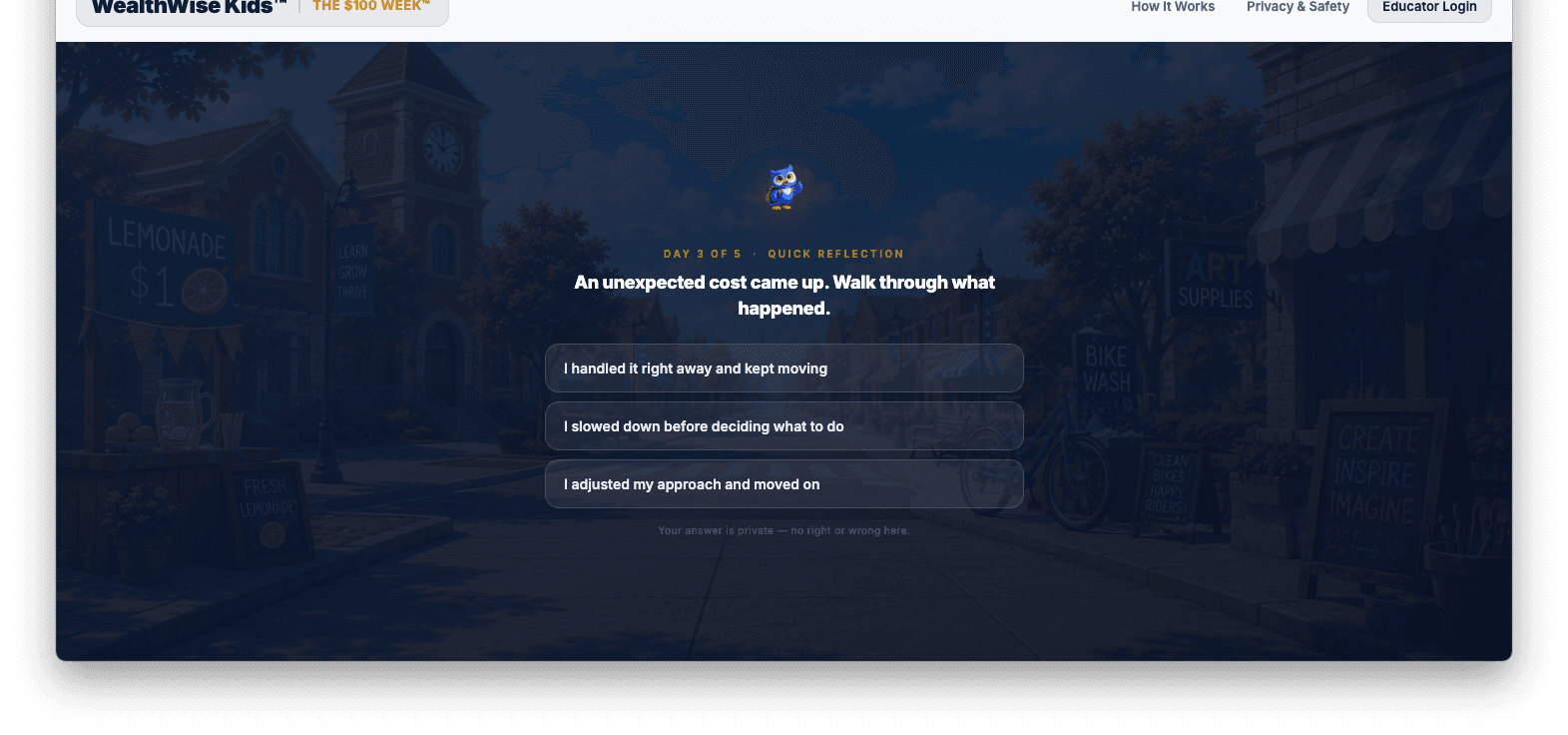
Most financial-literacy evidence is a knowledge test before and after. Knowing about money does not reliably change what people do with it. The FLIQ Score™ is read, through the FLIQ Score Model (FSM), from the choices a student makes inside the experiences: a trade-off in The $100 Week™, a saving decision in a lesson, a setback and what happens next.
Four decision traits
Impulse Control · Planning Orientation · Risk Awareness · Recovery Behavior. A trait a student never had the chance to show is marked no evidence, not scored.
Eight domains
Earning · Spending · Saving · Giving · Borrowing · Investing · Planning · Protecting.
One score, five bands
117–936. Explorer · Builder · Thinker · Innovator · Pioneer. Reported as a band and a number to adults; shown to a child as progress and moments, never as a rank.
What is not published
The scoring method and its parameters. They are proprietary to WealthWise Kids and shared with research partners under a confidentiality agreement, not on a web page.
How the first cohorts are run
Two readings, five weeks apart, the same instrument.
Step 1
First reading
The $100 Week™, five days in a browser, before any lesson. Every student gets a baseline from the same decisions.
Step 2
The program
Five weekly sessions of Financial Foundations™, one grade band, delivered by the school's own teacher or facilitator.
Step 3
Second reading
The same instrument, week five. The number that matters is the distance between the two readings.
Step 4
The report
Class median and band, trait and domain movement, participation, facilitator observations. Aggregate only. Individual profiles stay with the facilitator.
See the shape of the output: executive brief (PDF, 3 pages) · sample institutional impact report (PDF, 14 pages) · technical appendix (PDF, 10 pages) · validation brief · sample sponsor report · sample case study. Both are fictional and say so at the top.
§ Notation · FLIQ Score™ reporting
Reporting notation v1.0 · 2026
Traits
Domains
Readings
Scale 117–936 in five bands. Reported to adults as a band and a number; to a child as progress and moments, never as a rank. The scoring method is not published.

The evidence ladder
Nine rungs, climbed in order. Where we are on each.
We do not skip rungs for marketing convenience. A rung is marked done only when the thing exists and can be shown.
What the program is built on
The framework, the six research topics behind it, and the standards it maps to are in the evidence-base document and the standards hub.
Research & Evidence Base (download) →Standards →
For researchers
We are looking for an independent evaluator for the first cohorts and a university partner for the validation work. De-identified cohort data, the instrument’s derivation under agreement, co-authorship where earned.
Research partnerships →How children learn money. Once a month.
For the adults who teach it, fund it, and live with it. One email, one idea, one thing to try. Reply to unsubscribe; we do it by hand.